

Table of Contents
- Quick Comparison: Best Women Motorcycle Gear for Curves
- How to Choose a Motorcycle Jacket for Women With Curves
- Motorcycle Jeans for Curvy Women: Kevlar, Denim, and Stretch
- Women's Motorcycle Gear Sizing Guide: Measure Hips, Waist, and Inseam
- Abrasion Resistance and CE-Rated Armor: What Actually Protects You
- Tailoring, Weight, and Second-Hand Gear: What Most Guides Skip
- Conclusion: Building a Curves-Friendly Riding Kit
- Frequently Asked Questions
Last Updated: September 16, 2026
Quick Comparison: Best Women Motorcycle Gear for Curves
Finding the best women motorcycle gear for curves starts with one hard truth: most riding apparel is still built around a straight, narrow body, then scaled down and labeled "women's." This guide from BikerThreadsHQ cuts through that problem. Below you'll find a quick comparison of curves-friendly pants, then a full breakdown of how to choose a motorcycle jacket for women, how to size hips, waist, and inseam, and what CE-rated armor actually protects.
| Product | Price | Best For | Key Fit Feature |
|---|---|---|---|
| WOSAWE™ Riding Leggings | $89 | Everyday curves fit | Built-in knee pads, body-hugging cut |
| LOONG BIKER™ Motorcycle Jeans | $89 | Budget denim look | Stretch denim sizing chart |
| VOLERO™ Kevlar Jeans | $129 | All-round protection | 3D cutting, Kevlar lining |
| VOLERO™ Kevlar Cargo Pants | $139 | Touring and cargo storage | CE-1 hip and knee pads |
| LOONG BIKER™ Cross Fire Kevlar Jeans | $149 | Maximum abrasion resistance | Kevlar weave, elastic waistband |
How to Choose a Motorcycle Jacket for Women With Curves
Start with the shoulders, not the bust. A jacket that fits your shoulders and chest but leaves room at the waist can be cinched with adjustable waist straps; a jacket that's too tight across the chest restricts breathing and arm movement.
Look for these features when choosing a jacket:
- Articulated joints at the elbows and shoulders for reach to the bars
- Adjustable waist straps to pull in excess fabric
- CE-rated armor pockets at shoulders and back
- Stretch panels under the arms and across the back
- A length that covers your lower back when you're in riding posture
Motorcycle Jeans for Curvy Women: Kevlar, Denim, and Stretch
Motorcycle jeans for curvy women work best when the fabric stretches in two directions and the protective lining stays fixed. Stretch denim alone doesn't protect you; the Kevlar or aramid layer underneath does.
Three cuts dominate the curves-friendly market:
- Leggings-style: WOSAWE™ Riding Leggings ($89) hug the body and hold built-in knee pads in place, which suits commuting and shorter rides.
- Kevlar denim: VOLERO™ Kevlar Jeans ($129) use 3D cutting and a Kevlar lining, so the seat and thighs stay covered without pulling.
- Cargo: VOLERO™ Kevlar Cargo Pants ($139) add CE-1 hip and knee pads plus side pockets, and the elastic ankle bands slide into boots cleanly.
Women's Motorcycle Gear Sizing Guide: Measure Hips, Waist, and Inseam
A women's motorcycle gear sizing guide only works if you measure yourself, not a pair of jeans you already own. Riding pants sit differently than streetwear, and a size chart built on unstretched fabric will read smaller than the pants actually feel.
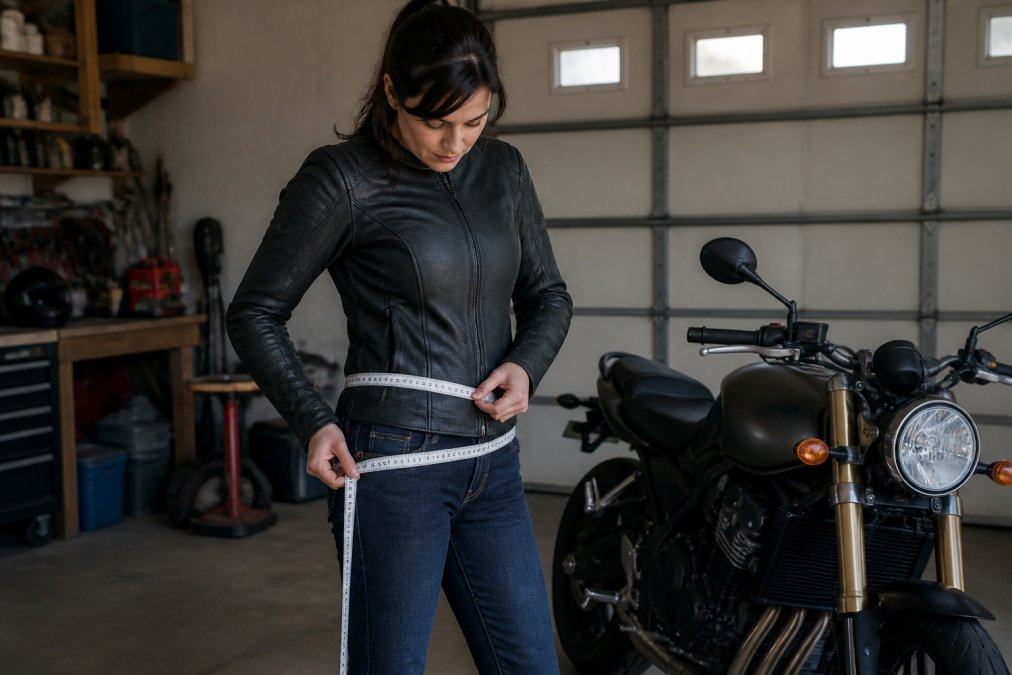
Measure in this order, wearing thin leggings:
- Waist: the narrowest point of your torso, above the navel.
- Hips: the fullest point of your seat, feet together.
- Inseam: from crotch to ankle bone, standing straight.
- Thigh: the fullest part of the upper leg, seated.
Abrasion Resistance and CE-Rated Armor: What Actually Protects You
Abrasion resistance and impact protection are two different jobs, and the best women's motorcycle gear for curves has to do both. Most buying guides blur them together. Here's the split that matters.
- CE Level 1, the baseline. Tested to transmit no more than a set amount of force through the pad. Fine for low-speed and commuting use.
- CE Level 2, absorbs more energy at the same impact. The better choice for highway and sport riding.
Why armor placement matters more on a curvy frame
Armor only works if it's between your bone and the road at the moment of impact. On a straight-cut pattern, knee armor sits centered on the knee. On a curvy frame, the same pocket can drift outward, so the pad lands beside the kneecap instead of over it. Hip protectors ride up above the hip bone. Back protectors sit too high and leave the lower spine exposed.
Look for these features when you're checking armor placement:
- Adjustable armor pockets you can reposition up, down, and side-to-side, not fixed stitching
- Hip protectors that sit at the widest point of the pelvis, not the waistband
- Knee armor that stays centered when you're seated on the bike, not just standing in the mirror
- Back protectors that cover the full spine length from the base of the neck to the tailbone
- Removable armor so you can swap in Level 2 pads without replacing the garment
Tailoring, Weight, and Second-Hand Gear: What Most Guides Skip
Most curves-focused gear guides stop at "buy the right size." That leaves three real problems unsolved: what to do when nothing off-the-shelf fits, how gear weight affects you over a long day, and whether used gear is safe. This section covers all three, the parts the top-ranking guides skip.
How to safely tailor riding gear
A good moto-tailor or heavy-duty seamstress can fix a lot of fit problems without compromising protection. The rule is simple: alter the fabric around the armor, never the armor itself.
WOSAWE™ Motorcycle Riding Leggings for →
What a tailor can safely do:
- Take in the waist of riding pants by opening the side seams, not the front, so the armor pockets stay anchored
- Shorten sleeves on a jacket that fits the shoulders but runs long, sleeve length should end at the wrist bone with your arms extended to the bars
- Add stretch panels at the hips or under the arms using abrasion-rated stretch fabric, not fashion elastic
- Reinforce seams with a double-stitch or bonded seam if the original stitching is single-stitch
What a tailor should never do:
- Remove, relocate, or replace armor pockets
- Cut into the abrasion-resistant lining (aramid, Kevlar, or leather) to "open up" the fit
- Use standard polyester thread on a protective garment, it fails under slide load
Gear weight and rider fatigue
Weight is the most under-discussed fit issue for curvy riders. A heavy leather jacket and stiff riding pants add up over a long day, and fatigue on a motorcycle is a safety factor, not just a comfort one. Reaction time drops, grip strength fades, and posture collapses, all of which make a bad situation worse.
A few practical patterns most riders notice:
- Textile and mesh gear generally weighs less than comparable leather and breathes better in heat
- Weight distribution matters more than total weight, a jacket that pulls on your shoulders is worse than a slightly heavier one that sits on your hips
- Cargo pants with loaded pockets shift weight down and back, which changes how you sit on the bike
- Layering systems let you add or remove insulation without swapping the whole outer shell
Buying second-hand plus-size gear safely
Many riders are priced out of new gear, and the used market is a legitimate option, if you know what to check. The order matters:
- Check the CE label stitching first. If the label is missing, faded, or sewn on aftermarket, treat the garment as fashion only.
- Inspect the abrasion lining. Aramid and Kevlar linings fray and thin with use. Hold the garment up to a light, thin spots and pinholes mean the lining is compromised.
- Replace all armor. Foam and viscoelastic pads degrade even when the outer shell looks fine. Budget for new CE-rated pads in the purchase price.
- Check the zippers and closures. A main zipper that sticks or a waist strap that's stretched out will fail when you need it most.
- Ask about crash history. A garment that's been down once may have compromised stitching even if the outer fabric looks intact.
Conclusion: Building a Curves-Friendly Riding Kit
The gear that protects you is the gear that fits you, and most riders settle for one or the other. Measure your hips, waist, and inseam, buy for your largest measurement, then adjust from there.
Frequently Asked Questions
What are the best motorcycle pants for curvy women?
Look for pants cut with a defined waist and room through the hip and thigh, not a scaled-down men's pattern. Kevlar-lined options such as the LOONG BIKER Cross Fire Kevlar Motorcycle Jeans ($149) use an elastic waistband, while the VOLERO Kevlar Cargo Style Motorcycle Pants ($139) add CE-1 hip and knee pads plus 3D tailoring. Stretch fabric and articulated knees matter more than a single waist number, because they let the pants move with you in the riding position.
How should a women's motorcycle jacket fit for curves?
The jacket should sit close without pulling across the chest or back, and the armor should stay put when you twist your torso. Check three things: the waist adjusters can tighten without bunching, the sleeves reach your wrist bone with arms extended to the bars, and the back protector does not ride up. If you size up to fit your bust or hips, expect to use the adjustment straps so the CE-rated armor stays over the impact zones rather than drifting to the side.
How do I measure myself for motorcycle gear to ensure a proper fit?
Use a soft tape over light clothing. Measure your bust at the fullest point, your natural waist at the narrowest part, and your hips at the widest point, usually 20cm below the waist. For pants, measure your inseam from crotch to ankle bone and add a few centimetres for the bent-knee riding position. Compare those numbers to each product's own chart, since sizing varies between the LOONG BIKER and VOLERO lines.
Where can plus-size female riders find protective motorcycle gear?
Start with brands that publish full measurement charts and show how the garment was measured, not just a letter size. BikerThreadsHQ lists hip, waist, and inseam figures for its women's pants, and notes a 0.4 to 0.8 inch tolerance on manual measurements, so you can pick the size that matches your largest measurement and adjust from there. Ordering one size based on your hips rather than your waist usually gives the best result for a curvy silhouette.
Is second-hand motorcycle gear safe to buy if I'm curvy?
It can work, but inspect carefully. Kevlar and denim linings lose abrasion resistance after a slide, so check for scuffed panels, thinning fabric, and stretched seams. Armor is often missing or compressed, and you may not be able to replace it in the original size. A jacket that has already molded to someone else's body will not hold armor in the right place on yours, which matters most around the hips and shoulders.