

Table of Contents
- Why Accurate Measurements Matter for Riding Safety
- Step-by-Step Guide: How to Measure Motorcycle Jacket Size
- How Tight Should a Motorcycle Jacket Be?
- Motorcycle Jacket Size Chart: Decoding the Numbers
- Measuring for Leather vs Textile Jackets
- Account for Body Shape and Layering
- Brand Sizing Inconsistencies and How to Handle Them
- Conclusion: Ride Confident with the Perfect Fit
- Frequently Asked Questions
Last Updated: September 6, 2026
Finding the right motorcycle jacket size is the difference between armor that stays put in a slide and armor that shifts when you need it most. Here is the exact method for how to measure motorcycle jacket size so you can order with confidence.

A properly fitted jacket keeps CE-rated armor pressed against your body yet allows a full range of motion. Don't buy based on your t-shirt size; motorcycle jackets are cut for a riding position, with forward-set sleeves and a shorter torso.
Why Accurate Measurements Matter for Riding Safety
A loose jacket is a false sense of security. If it shifts on impact, elbow pads and back protector can move out of position, leaving you unprotected. Armor only works when it stays anchored to your body.
Ergonomics also depend on fit. A jacket that is too tight restricts your reach and head check; one that is too long bunches up behind your lower back.
Step-by-Step Guide: How to Measure Motorcycle Jacket Size
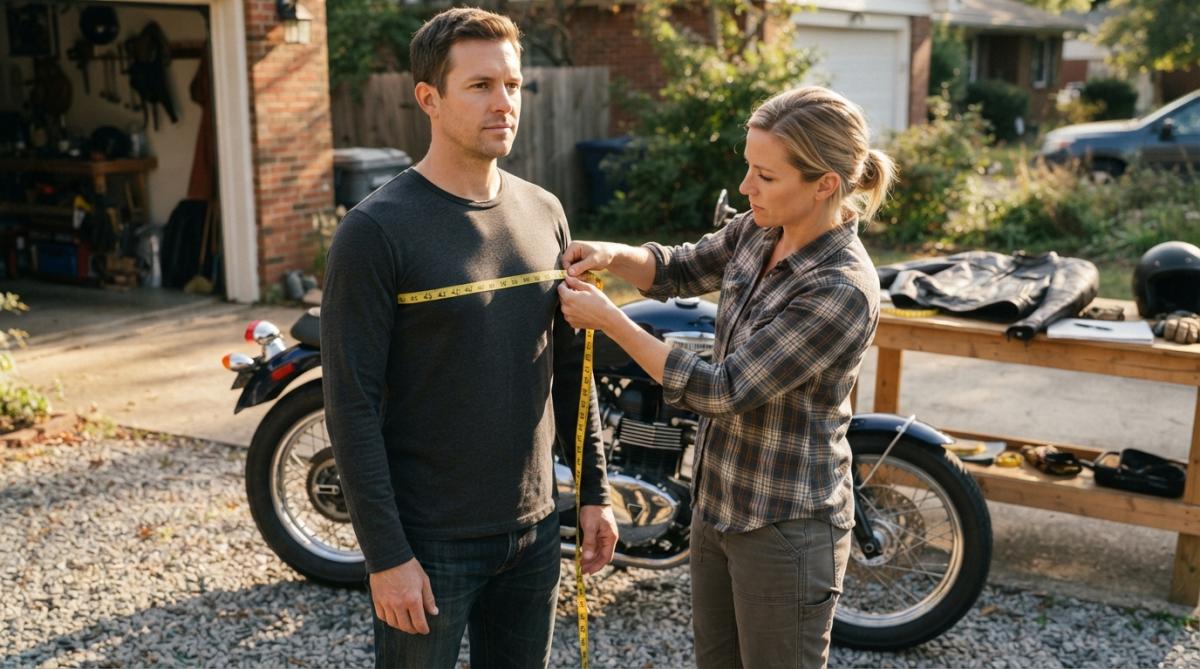
Grab a flexible fabric tape measure and wear the base layer you plan to ride in. Stand naturally with arms relaxed. Have a friend help if possible, since self-measuring often leads to a too-loose reading. Take each measurement twice.
Chest Circumference: The Primary Measurement
Chest circumference is the most important number for determining your size. Wrap the tape around the fullest part of your chest, level under your armpits and across your shoulder blades. Keep one finger between the tape and your body to avoid pulling too tight. This is the baseline you'll compare against a size chart.
Sleeve Length and Shoulder Width
Sleeve length is measured from the center of your back at the base of your neck, across the shoulder, and down to your wrist bone. For shoulder width, measure seam-to-seam across your back. Since riding jackets have pre-curved sleeves, this ensures cuffs reach your wrists without pulling when your hands are on the grips.
Torso Length and Waist Measurement
Torso length determines how much coverage you get on the bike. Measure from the base of your neck down your spine to where you want the jacket to end, usually around your waistline. The waist measurement is taken at your natural waist, roughly at your belly button, since many jackets have adjustable straps there.
How Tight Should a Motorcycle Jacket Be?
A motorcycle jacket should fit snugly, like a firm handshake, without restricting movement. You should feel armor touching your shoulders and elbows, but no pressure points in the riding position. If you can pinch more than an inch of fabric at your ribs, it's too loose.

To test the fit, mimic your riding posture. Reach forward as if gripping the handlebars. The back should stay smooth without bunching, and sleeves should not ride up your forearms. If it pulls across the shoulders or restricts your neck, size up.
Motorcycle Jacket Size Chart: Decoding the Numbers
Understanding how your measurements translate to a jacket size removes the guesswork. Most manufacturers use the chest measurement as the primary driver for sizing.
| Measurement | Size S | Size M | Size L | Size XL | Size 2XL |
|---|---|---|---|---|---|
| Chest Circumference | 34-36 in | 38-40 in | 42-44 in | 46-48 in | 50-52 in |
| Sleeve Length | 32-33 in | 33-34 in | 34-35 in | 35-36 in | 36-37 in |
| Waist | 28-30 in | 32-34 in | 36-38 in | 40-42 in | 44-46 in |
This chart is a starting point, not a guarantee. A track jacket meant for a tucked position will fit tighter than an adventure jacket designed for layering. Always compare your chest circumference against the specific jacket's size chart, and note whether the brand lists measurements in inches or centimeters.
Measuring for Leather vs Textile Jackets
The material changes how the fit should feel. Leather jackets are stiff when new and will stretch and mold to your body over time, so they should fit snug from day one; one that feels comfortable in the store will likely be too loose after a season (peer-reviewed research).
Textile jackets, on the other hand, do not stretch. They are built with multiple layers and a fixed shape, so what you feel at the store is what you get on the road. When measuring for one, leave a little more room for a base layer and the liner that many all-season jackets include.
Account for Body Shape and Layering
Standard size charts assume a proportional build, but few riders have perfectly uniform dimensions. Here’s how to adapt your measurements for common rider builds.
For Tall and Slim Riders
If you are tall and lean, your chest measurement may fall into a size Medium, but the torso and sleeve length of a standard Medium will likely be too short.
- The Problem: A jacket that fits your chest will ride up your back when you reach for the handlebars, and the sleeves will expose your wrists.
- The Solution: Look for jackets with a "long" or "tall" cut. Many adventure and touring jackets offer this. If a tall size isn't available, prioritize sleeve and torso length over a perfectly snug chest fit. A slightly roomier chest is a safer compromise than exposed wrists and lower back.
- Measurement Tip: When measuring your torso, add 1-2 inches to your target endpoint to ensure adequate coverage in the riding position.
For Athletic and Muscular Builds
Riders with a muscular chest, shoulders, and back often face the opposite problem. A jacket that fits your chest and shoulders may be excessively baggy around your waist and abdomen.
- The Problem: Excess fabric at the waist can bunch up and create uncomfortable pressure points against the tank.
- The Solution: Prioritize jackets with robust waist cinch straps or adjustable side lacing. These allow you to tailor the lower half of the jacket to your torso. Take your chest and waist measurements separately. If the difference between the two is larger than the size chart indicates, the jacket's adjustability is your primary tool.
- Measurement Tip: When trying on a jacket, sit on your bike in the riding position. If the waist creates a 'balloon' of fabric, the cinch system needs to pull it in significantly. If it can't, you need a different cut.
For Stocky or Broader Builds
If you have a larger chest and abdomen, a jacket sized for your chest may be too tight across the back or restrict your arm movement.
- The Problem: A jacket that is too tight across the shoulders will pull when you reach for the handlebars, compromising control (the CDC).
- The Solution: Focus on shoulder width and back width, not just the chest. A sport-bike cut (with a pronounced forward lean) may be too restrictive. Consider a more upright, adventure-style cut with more room in the shoulders and upper back.
- Measurement Tip: When measuring your chest, ensure the tape is level and not pulled down by a large abdomen. Measure the fullest part of your chest, which for some riders may be higher or lower than the standard armpit line.
Layering: The Seasonal Fit Equation
Your motorcycle jacket is not a single-season garment for most riders. Decide on your primary riding season and measure for that, then use a layering system for other times.

- Summer Riding (Base Layer Only): Measure over a thin t-shirt or moisture-wicking base layer. This is your baseline fit.
-
Winter Riding (Mid-Layer Included): If you plan to ride in cooler weather, you have two options:
- Size Up: Purchase a jacket one size larger to accommodate a fleece or insulated mid-layer. This is the simplest approach but can compromise safety in the summer when the jacket is too loose.
- Use a Layering Shell: Invest in a textile or mesh jacket with a roomier cut and add a separate, insulated liner or a heated vest underneath. This allows you to keep the same jacket year-round and adjust insulation independently.
- Measurement Tip: If you choose to size up for layering, take your measurements while wearing your thickest mid-layer. Do not guess. A jacket that is too large over a t-shirt is a safety hazard because the armor will not stay in place.
By understanding how your body shape deviates from the 'standard' size chart model and how layering changes the equation, you can make a more informed choice that prioritizes both safety and comfort.
Brand Sizing Inconsistencies and How to Handle Them
Different brands cut their jackets differently, and even different models within the same brand can vary. A size Large in one manufacturer's sport jacket may fit like a Medium in their cruiser line. Measuring your body is only half the battle; the other half is comparing your numbers to the specific jacket's size chart.
Why the Same Letter Size Means Different Things
The root of the problem is that there is no universal standard for motorcycle apparel sizing. Unlike helmets, which are regulated by DOT and ECE standards for safety, jackets have no such regulatory body for fit (nhtsa.gov). Each brand develops its own 'block' or pattern based on its target market.
- Geographic Origins: European brands (like Alpinestars, Dainese, Rev'it) typically use a slimmer, more athletic 'Euro' cut. Their size 50 (EU) is roughly equivalent to a US size Medium, but sleeves are often longer and the torso shorter. Asian brands may run a full size smaller. American brands (like First Mfg., Milwaukee Leather, and many custom shops) often use a more generous 'US' cut, with a roomier torso and shoulders.
- Riding Style: A brand's racing line (e.g., Alpinestars' GP Plus) is cut for a severe forward lean, with pre-curved sleeves and a very short torso. Their adventure line (e.g., Alpinestars' Toucan) is cut for an upright position, with a longer torso and more room for layering. A size Large in the racing line will feel significantly tighter than a size Large in the adventure line from the same brand.
The 'Measurement Mapping' Method
Instead of relying on the letter size, use this three-step process to compare jackets from different brands:
- Record Your Body Measurements: You already have your chest, waist, and sleeve length. Write these down.
- Find the 'Garment Measurement' Chart: Most quality brands provide a chart listing the actual measurements of the jacket itself (e.g., pit-to-pit, shoulder width, sleeve length), not just the body measurements they correspond to. This is the most accurate data you can get. If a brand only lists body measurements, look for a note about how much 'ease' (extra room) they have built in.
- Compare, Don't Convert: Do not try to convert a US size to a Euro size. Instead, compare your body measurements to the garment measurements for each specific jacket. For example, if your chest is 42 inches, a jacket with a 44-inch pit-to-pit will be snug, while a 46-inch pit-to-pit will allow for a base layer.
How to Use Reviews and Community Knowledge
Size charts are a starting point, but real-world experience is invaluable. When shopping online, read the reviews specifically for fit feedback.
- Look for Key Phrases: Search for terms like "runs small," "runs large," "fits true to size," "tight in the shoulders," or "long in the torso." A single review mentioning a size issue is an outlier; three or more mentioning the same issue is a pattern you should trust.
- Check the Reviewer's Stats: Many review sections allow users to list their height, weight, and normal jacket size. If you find a reviewer with similar measurements to yours, their feedback on which size they purchased and how it fit is the most relevant data you can find.
- Use the Brand's Customer Service: A good brand's customer service team can often provide specific guidance on how a jacket fits compared to another model in their own lineup. Ask them: "I wear a size Large in your Horizon jacket. How does the fit of the Milwaukee Leather jacket compare?"
By treating brand sizing as a variable to be managed rather than a constant to be assumed, you can confidently select the jacket that fits your body, not just a label.
Conclusion: Ride Confident with the Perfect Fit
Measuring your motorcycle jacket size takes five minutes and saves you the hassle of returns and the risk of riding unprotected. The process comes down to three numbers: chest circumference, waist, and sleeve length, all taken over your riding base layer. Compare those numbers to the specific jacket's size chart, and account for the material's behavior.
At BikerThreadsHQ, we design our gear for riders who demand both protection and style. Whether you are drawn to the versatile Horizon Motorcycle Jacket with its adjustable, flexible fit or the all-season durability of a Milwaukee Leather textile option, our size charts are built to get you the right fit the first time. Get started with BikerThreadsHQ and ride with the confidence that comes from gear that fits.
Frequently Asked Questions
Should a motorcycle jacket be tight or loose?
A motorcycle jacket should be snug, not tight or loose. It must fit close to your body so the armor stays in place during a slide. You should be able to pinch about an inch of fabric at the chest. Raise your arms above your head; the jacket should not pull up excessively. While it should feel firm, you need full range of motion to reach the handlebars comfortably.
Do motorcycle jackets run small or large?
Motorcycle jackets often run smaller than regular clothing sizes because they are designed to fit snugly for protection. Many riders need to size up compared to their dress shirt size. However, this varies widely between brands and between leather and textile styles. Always check the specific brand's size chart and measure your chest circumference rather than relying on your usual jacket size.
How do I measure my chest for a motorcycle jacket?
Wrap a fabric tape measure around the fullest part of your chest, keeping it level under your armpits and across your shoulder blades. Keep one finger between the tape and your chest for a comfortable fit. Record the measurement in inches or centimeters. This chest circumference is the most important number for determining your motorcycle jacket size.
How should a leather motorcycle jacket fit compared to textile?
A leather jacket should fit very snugly from day one because leather stretches and molds to your body over time. It should feel almost like a second skin. A textile jacket should fit snugly but allow a bit more room for movement and layering, since textile materials do not stretch the way leather does.