

Table of Contents
- What Does the CE Rating on a Jacket Actually Tell You?
- The Difference Between CE and Non-CE Gear
- Understanding EN 17092: Abrasion Resistance Ratings for Motorcycle Jackets
- CE Level 1 vs Level 2 Armor: Which One Do You Need?
- How to Spot the CE Label and the 'Fake CE' Problem
- Does a CE Rating Mean the Jacket Is Crash-Proof?
- How CE Ratings Change With Wear and Tear
- Conclusion
- Frequently Asked Questions
Last Updated: September 4, 2026
What Does the CE Rating on a Jacket Actually Tell You?
A CE rating on a motorcycle jacket is a legal declaration that the garment meets specific European safety standards for impact protection and abrasion resistance.
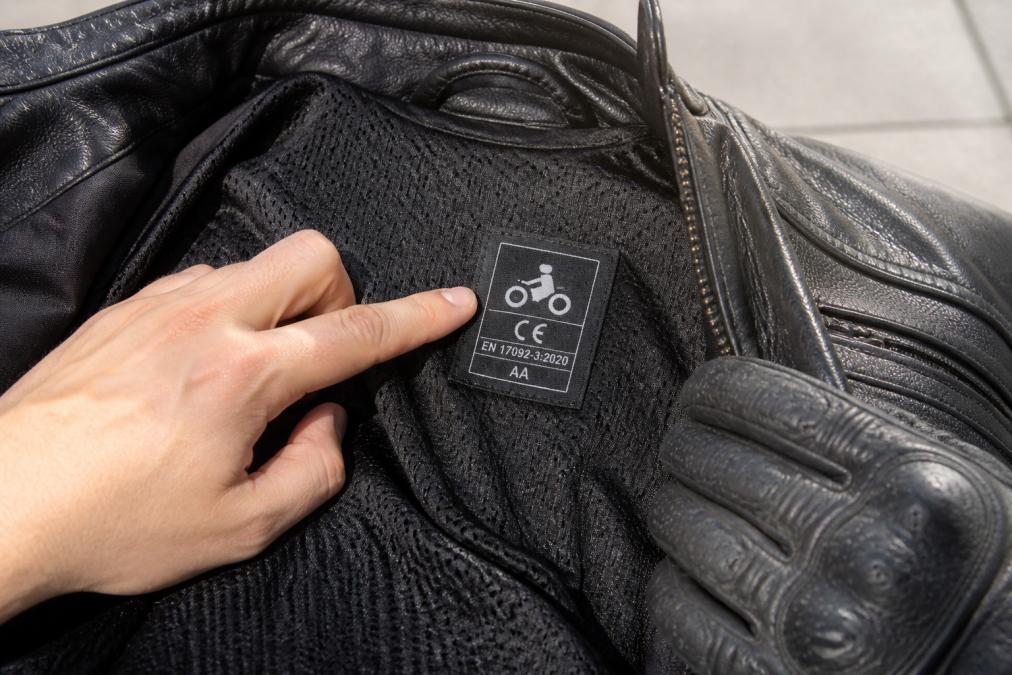
CE stands for Conformité Européenne, and for motorcycle clothing it covers two distinct areas: the armor (tested under EN 1621-1) and the fabric of the jacket itself (tested under EN 17092) (ec.europa.eu).
Most riders assume a CE mark means the whole jacket is equally protective, but that is rarely true. The armor might be rated for high impact while the textile offers minimal abrasion resistance, or vice versa.
The Difference Between CE and Non-CE Gear
Non-CE gear makes no verified promises about protection. A jacket without a CE rating may use materials that look durable but have never undergone standardized testing.
A CE-rated jacket has been tested in certified facilities against specific thresholds for tear strength, seam burst, and abrasion resistance.
A CE mark does not mean the jacket is indestructible. It means the garment has met a minimum baseline of mechanical resistance that non-CE gear cannot claim.
Understanding EN 17092: Abrasion Resistance Ratings for Motorcycle Jackets
EN 17092 is the harmonized standard that classifies motorcycle protective clothing by abrasion resistance, dividing garments into classes AAA, AA, A, B, and C, with AAA offering the highest protection.
The class is determined by testing the fabric's resistance to abrasion, tear strength, and seam burst under controlled conditions. A jacket rated AA has passed more demanding tests than a Class A jacket.
When you look at motorcycle jacket abrasion resistance ratings, focus on the class letter, not just the presence of a CE tag. A Class A jacket suits urban commuting at lower speeds, while AAA is built for high-speed track or touring use.
The table below summarizes how the classes break down for practical use:
| EN 17092 Class | Protection Level | Typical Use Case | Key Testing Focus |
|---|---|---|---|
| AAA | Highest | Track days, high-speed touring | Abrasion, tear, seam burst |
| AA | High | Sport touring, spirited riding | Abrasion, tear, seam burst |
| A | Moderate | Urban commuting | Basic abrasion resistance |
| B | Basic | Low-speed city riding | Limited abrasion testing |
| C | Limited | Over-jackets only | No abrasion requirement |
CE Level 1 vs Level 2 Armor: Which One Do You Need?
CE armor ratings refer to the impact protectors in the elbows, shoulders, and back, tested under EN 1621-1. The distinction between Level 1 and Level 2 comes down to how much impact force is transmitted through the protector.
Level 1 armor transmits a maximum average force of 18 kilonewtons during impact testing; Level 2 allows a maximum of 9 kilonewtons (PubMed). In plain terms, Level 2 absorbs more crash energy.
For most street riders, Level 2 armor in the back and Level 1 in the limbs is a balanced choice. Level 2 armor is often thicker and less flexible, affecting comfort over long rides. Many premium jackets come with Level 2 back protectors as standard because the spine is particularly vulnerable.
The Armor Compatibility Question Most Guides Ignore
Here is the part that almost no guide explains: swapping armor between jackets can void the garment's CE certification. The EN 17092 and EN 1621-1 standards are tested together as a system with the specific armor pieces that ship with it.
If you remove the original Level 1 elbow protectors and drop in thicker Level 2 protectors from another brand, you change the geometry of the protective zone. The new armor might sit at a different angle, shift in a crash, or not cover the same area, voiding the certification.
That does not mean you can never upgrade armor. Check three things before you swap:
- Pocket dimensions, Measure the existing pocket. Level 2 armor is often 2-3 mm thicker than Level 1, and it may not fit flush in a pocket designed for slimmer protectors.
- Armor shape and curvature, Jacket armor is not flat. It is contoured to wrap around elbows and shoulders. A different brand's protector may have a different curve, leaving gaps between the armor and your body.
- Manufacturer policy, Some brands explicitly state that using third-party armor voids the warranty and the CE certification. Others, like Dainese and Alpinestars, sell their own upgrade paths with armor designed for their pockets.
A Practical Sizing Note
Armor sizes are not universal. A "Level 2 back protector" from one brand may be sized for a specific jacket model. The CE test measures the protector in isolation, but real-world performance depends on whether it stays in place over your spine during a slide.
When you buy a jacket, check whether the armor is removable and how it is secured. Hook-and-loop closures and zippered pockets are more reliable than friction-fit sleeves.
The Hidden Cost of Level 2
Level 2 armor is not just thicker; it is often heavier. A full set can add 300-500 grams to a jacket compared to Level 1, contributing to fatigue over a full day of riding. For urban commuters the difference is negligible; for adventure riders doing 8-hour days, it matters.
Some manufacturers use multi-layer foam or viscoelastic materials that soften with body heat to reduce the bulk penalty. These premium protectors cost more but offer a better balance of protection and comfort.
What to Look For in the Label
When you inspect armor, look for the EN 1621-1 marking followed by the level number. A genuine Level 2 protector will have "EN 1621-1:2014 Level 2" printed on the foam or a sewn-in tag. Some protectors also carry a "Type B" designation, meaning they offer coverage over a larger area. Many jackets ship with a thin foam pad that is not CE-rated at all, it is there for comfort, not protection.
The Bottom Line for Buyers
Before you buy, decide whether the jacket's stock armor meets your needs. If you want Level 2 protection everywhere, look for a jacket that ships with it rather than planning an upgrade later. Never assume that a CE mark on the jacket covers armor you installed yourself, it does not.
How to Spot the CE Label and the 'Fake CE' Problem
A genuine CE label is not just a small printed tag. It should reference the specific standard, such as EN 17092-3:2020 for Class AA garments, and include the manufacturer's details. Look for a sewn-in label, not a removable paper hang tag.
The 'Fake CE' problem is real. Some manufacturers print a CE mark without testing their products to the standard. The official CE marking for PPE is regulated, and legitimate manufacturers must hold documentation proving their garments passed testing in certified facilities (osha.europa.eu).
Here is how to verify a jacket's rating:
- Check for the specific EN number, not just the CE logo
- Look for the class letter (AAA, AA, A) in the label
- Confirm the armor has its own EN 1621-1 marking
- Buy from reputable sellers who can show the certification documentation
Does a CE Rating Mean the Jacket Is Crash-Proof?
A CE rating does not mean the jacket is crash-proof. It means the jacket has met minimum thresholds in controlled laboratory tests for impact and abrasion. Real-world crashes involve variables lab tests cannot fully replicate.
Think of the rating as a floor, not a ceiling. It guarantees a baseline of protection that should prevent the worst abrasion injuries in a slide, but it does not guarantee that bones will not break or that the jacket will survive a direct high-speed impact.
The testing protocols measure shock absorption and abrasion resistance in isolation, not every possible crash scenario. Riding within your limits and wearing appropriate armor remains the most reliable safety strategy.
How CE Ratings Change With Wear and Tear
CE ratings are not permanent. The protective qualities of a jacket degrade over time through use, exposure to the elements, and improper storage. A jacket that passed its tests when new may not offer the same protection after years of riding.
Leather and textile fibers weaken with repeated flexing and UV exposure. Armor, particularly the foam in impact protectors, hardens or compresses over time. A common mistake is assuming the CE rating remains valid for the life of the garment.
Check your gear regularly for signs of wear in the protective zones. Look for thinning fabric, cracked leather, or armor that has lost its shape. Most manufacturers recommend replacing armor after a significant impact and considering new gear every few seasons if you ride frequently.
The Degradation Timeline Nobody Talks About
The CE rating is a snapshot of how the jacket performed when it left the factory. Here is what actually happens over time:
UV exposure (months 6-18): The sun's ultraviolet rays break down the polymers in textile fibers and the dyes in leather. Textile jackets with a waterproof membrane are especially vulnerable, the membrane can delaminate from the outer shell after repeated sun exposure, reducing both abrasion resistance and weather protection.
Sweat and moisture (months 12-24): Human sweat is mildly acidic and can corrode the stitching that holds protective panels together, especially in high-sweat areas like the collar and underarms. Always hang your jacket to dry completely before storing it, and consider using a moisture-wicking base layer.
Repeated flexing (months 24-48): Every time you bend your elbows and shoulders, you stress the fabric at the joints. After two to three years of regular riding, the fibers in these zones can fatigue even without visible damage. Run your fingers along the inside of the elbows and feel for thinning or a change in texture.
Armor compression (months 18-36): The foam in impact protectors is designed to absorb one significant impact. Even without a crash, the foam slowly compresses under the weight of the jacket when folded or stored improperly. If your back protector feels noticeably softer or thinner than when you bought it, it has lost some energy-absorbing capacity.
The Washing Problem
Most riders never wash their motorcycle jackets, and that is actually the safer choice. When you do wash a textile jacket, the detergent and agitation can break down the DWR (durable water repellent) coating and weaken the fibers. If you must wash your jacket, follow these rules:
- Use a technical cleaner designed for motorcycle gear, not standard laundry detergent
- Wash on a gentle cycle in cold water
- Never use fabric softener, it coats the fibers and reduces breathability
- Air dry only, away from direct heat sources
- Re-apply a DWR treatment after washing to restore water resistance
Leather jackets have their own rules. Leather conditioners can soften the hide, but over-conditioning can make it too supple, reducing its abrasion resistance. An over-conditioned jacket will not slide across asphalt as well as one with proper tension in the hide.
How to Tell If Your Jacket Has Lost Its Rating
There is no home test that can measure abrasion resistance. But there are visual and tactile cues that should prompt you to replace your gear:
- Fabric sheen changes: If the outer shell has developed a shiny, polished look in the elbows or shoulders, the fibers have been compressed and may be close to failing
- Stitching that pulls or frays: The seams are tested for burst strength. If you see loose threads or gaps between panels, the seam integrity is compromised
- Armor that does not bounce back: Press your thumb into the armor. If it does not spring back to its original shape within a few seconds, the foam has lost its resilience
- Cracked or peeling leather: This is a sign that the leather has dried out and lost its tensile strength
The Replacement Rule of Thumb
Most manufacturers suggest replacing armor after any significant impact, even if the foam looks fine, because the internal structure can be damaged without visible cracks. For the jacket itself, a reasonable guideline is:
- Daily riders: Replace every 3-5 years
- Weekend riders: Replace every 5-7 years
- After any crash: Replace immediately if the jacket touched the ground
These are not hard rules, they depend on storage conditions, climate, and maintenance. If you are buying a used jacket, treat the CE rating with skepticism. A five-year-old jacket stored in a garage in Arizona has almost certainly degraded more than a three-year-old jacket kept in a climate-controlled closet.
Why This Matters for Your Purchase Decision
When you buy a jacket, you are not just buying protection for today, you are buying a safety system that must perform years from now. A jacket with a higher abrasion rating (AA or AAA) will typically use denser materials that degrade more slowly than the lighter fabrics used in Class A jackets.
Check the manufacturer's care instructions before you buy. If a jacket requires special storage or cleaning that you cannot commit to, factor that into your decision. The best CE rating is worthless if the jacket has been left crumpled on a garage floor for three years.
Conclusion
Understanding what a CE rating means is the difference between buying a jacket for its looks and buying one for its ability to protect you. The system is layered: EN 17092 covers the fabric's abrasion resistance, while EN 1621-1 covers the armor's impact protection.
The challenge is finding gear that balances certified protection with comfort and style for long rides. At BikerThreadsHQ, we stock premium motorcycle apparel that combines rugged, American-inspired design with certified protective standards. Get started with BikerThreadsHQ and ride with the confidence that your jacket has been tested to protect you.
Frequently Asked Questions
Is CE Level 1 or 2 armor better for a motorcycle jacket?
Level 2 armor absorbs more impact energy than Level 1, passing a stricter test with a lower maximum transmitted force. It offers a higher degree of protection, which is why many riders choose it for the back and chest. The trade-off is that Level 2 armor is often thicker and less flexible, which can affect comfort. For urban riding, Level 1 might be sufficient, but for higher-speed touring or track days, Level 2 provides a greater safety margin.
What do the letters A, AA, and AAA mean on motorcycle jacket labels?
These letters are part of the EN 17092 standard and classify the jacket's abrasion resistance. Class A is for basic urban riding with the lowest level of protection. Class AA is designed for sport touring and offers a higher level of abrasion and tear resistance. Class AAA is the highest rating, suitable for high-speed riding, and uses the toughest materials like heavy leather or advanced textiles. The rating reflects the coverage and quality of protection in the key impact zones.
Does a CE rating guarantee the jacket is crash-proof?
No. A CE rating means the jacket has passed specific laboratory tests for abrasion, tear, and impact resistance under controlled conditions. It does not guarantee you will walk away from a crash without injury. The outcome depends on the speed of impact, the angle of the slide, and the surface you hit. The rating is a benchmark for comparing the relative protective quality of gear, not a promise of invincibility. It's a critical tool for making an informed purchase.
How can I tell if my jacket's CE rating is legitimate?
Look for the CE mark on the garment's label, which must be accompanied by a four-digit number identifying the notified body that certified it. For armor, check for the EN 1621-1 standard marking. Be wary of jackets that only say 'CE' with no standard or reference, as this can be a sign of a fake rating. Buying from reputable dealers who source from certified manufacturers is the most reliable way to ensure the gear meets genuine safety standards.
This article was written using GrandRanker