

Table of Contents
- Why a Proper Fit Matters More for Women Riders
- Leather vs Textile Motorcycle Jacket: Which Material Wins?
- Understanding Motorcycle Jacket Armor Types
- How to Measure for a Motorcycle Jacket That Fits Your Body
- Matching the Jacket to Your Riding Style and Climate
- Common Mistakes to Avoid When Buying a Women's Jacket
- Conclusion: Your Checklist for the Perfect Jacket
- Frequently Asked Questions
Last Updated: September 4, 2026
Finding a motorcycle jacket that fits properly is the single biggest safety decision a rider makes, yet women face a market where many options are simply scaled-down men's designs. The process of how to choose motorcycle jacket for women comes down to three pillars: genuine anatomical fit, certified impact protection, and material that matches your riding environment.
The stakes are higher than comfort. A jacket that shifts or bunches because it is cut for a different body type leaves gaps in coverage at the exact moment you need it most.
Why a Proper Fit Matters More for Women Riders
A motorcycle jacket for women must accommodate a narrower waist, a fuller bust, and often a longer torso relative to leg length compared to men's standard cuts. When a jacket is too loose in the waist, armor migrates away from the elbow and shoulder joints during a slide; when it is too tight across the chest, you cannot reach the handlebars comfortably, compromising steering control and creating pressure points that fatigue you on long rides.
The riding position dictates the fit. Sport bike riders lean forward, so the jacket needs longer sleeves and a shorter front waist to prevent bunching. Cruiser and touring riders sit more upright, requiring a straighter torso cut and room in the shoulders. Many brands fail women here by using a single blocky pattern, which is why measuring your torso length and comparing it to the jacket's back length matters more than any letter size.
Leather vs Textile Motorcycle Jacket: Which Material Wins?
The choice between leather and textile is a trade-off between abrasion resistance and versatility. Full-grain leather offers the highest abrasion resistance in a single layer and molds to your body over time (peer-reviewed research). Textile jackets, typically made from high-denier nylon or polyester, are lighter, breath better in summer, and often ship with a waterproof membrane and thermal liner built in.
For a motorcycle jacket for women, the decision hinges on your climate and riding style. Leather excels for city commuting and weekend rides in temperate weather; textile is the better choice for long-distance touring and wet climates. Many serious riders own both, but if you are buying one jacket, consider your dominant conditions first.
| Material | Abrasion Resistance | Weather Protection | Best For |
|---|---|---|---|
| Full-Grain Leather | Highest single-layer | Poor, requires separate rain gear | City, cruisers, classic style |
| Textile (Nylon/Poly) | Good, varies by denier | Excellent with membrane | Touring, commuters, wet climates |
Understanding Motorcycle Jacket Armor Types
Armor is the difference between a jacket and a costume. Modern motorcycle jacket armor falls into two categories: CE-rated armor and simple foam padding.
The Mechanics of Impact Protection
CE-rated armor, certified under the EN 1621-1 standard, absorbs impact energy through materials that deform or crush in a controlled manner (fim-moto.com). The most common materials are:
- Viscoelastic (memory) foam: This material is soft and flexible at rest but stiffens upon impact, spreading the force over a larger area. It's often used in higher-end armor like D3O or SAS-TEC.
- Hard plastic or polypropylene shells: These are rigid cups that sit over the joint, deflecting and spreading the initial impact force. They are often found in more budget-friendly jackets.
- Multi-layer foam composites: These combine different densities of foam to manage both low- and high-energy impacts.
The EN 1621-1 standard tests armor by dropping a specified mass from a set height and measuring transmitted force. Level 1 armor transmits a maximum average force of 18 kN, while Level 2 armor must transmit less than 9 kN. However, Level 2 armor is often thicker and less flexible, which can affect comfort.
The Difference Between Armor and Jacket Ratings
A common point of confusion is the difference between the armor's rating (EN 1621-1) and the jacket's overall safety rating (EN 17092). The jacket rating, from Level A to Level AAA, assesses abrasion resistance, seam strength, and burst strength (unece.org). A jacket can be rated Level AAA but still come with only Level 1 armor or no armor at all. You need both.
Armor Placement and the Female Anatomy
For women, armor placement is about whether pads stay in place during a slide. Because women's shoulders and elbows are often narrower than men's, armor pockets in a unisex jacket can sit too far out, leaving the joint exposed. When trying on a jacket, raise your arms as if grabbing the handlebars and have a friend press on the armor. It should sit firmly over the point of your shoulder and the tip of your elbow. If it shifts, the cut is wrong.
Back Protectors: The Most Critical Upgrade
Most jackets come with a pocket for a back protector, but it is often sold separately. A back protector is arguably the most important piece of armor, protecting your spine in a high-side or rear-end impact. If not included, factor the cost of a CE-rated Level 2 back protector into your budget.
Upgrading Armor: A Smart Investment
Many textile jackets can accommodate an upgrade from Level 1 to Level 2 armor. Brands like D3O and SAS-TEC offer aftermarket Level 2 inserts for standard-sized pockets. Check pocket dimensions and armor shape to ensure a proper fit.
How to Measure for a Motorcycle Jacket That Fits Your Body
To measure for a motorcycle jacket, you need three numbers: chest circumference, waist circumference, and torso length from the base of your neck to your natural waist. Use a soft measuring tape over a thin base layer, keeping it snug but not tight.
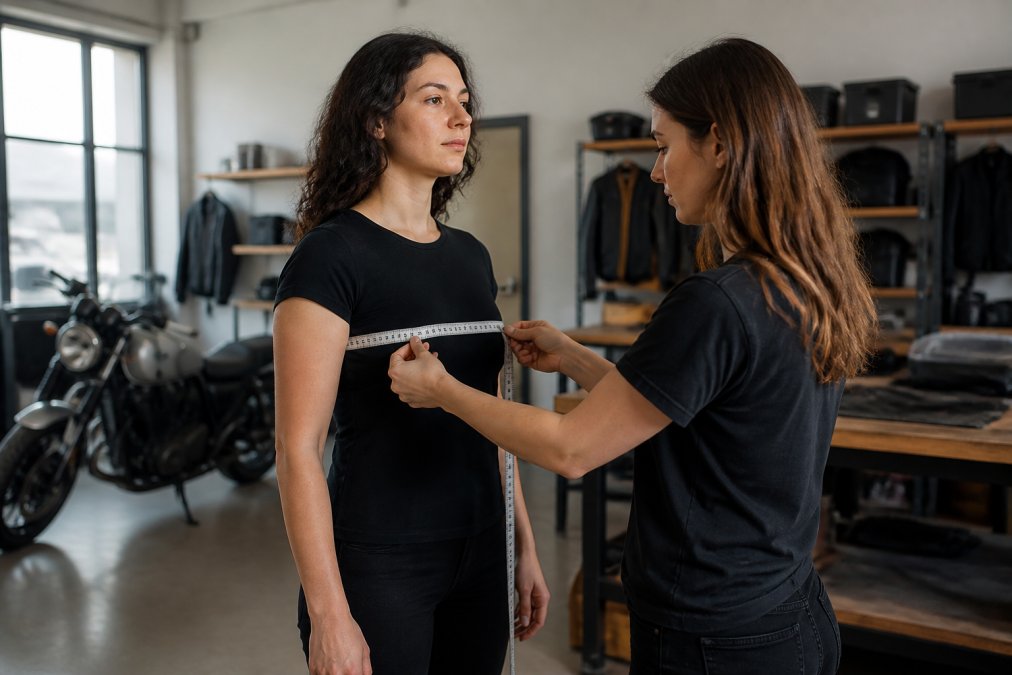
Once you have these numbers, compare them against the jacket's specific size chart. Pay attention to sleeve length: with arms extended toward the handlebars, the cuff should sit at your wrist bone without riding up. The jacket should feel snug when zipped, but you must be able to cross your arms in front of your chest without strain.
A crucial step is the "riding test." Sit on your bike, or mimic the riding position on a chair, and have someone check that the jacket does not ride up your lower back or pull across the shoulder blades.
Matching the Jacket to Your Riding Style and Climate
Your riding style determines the jacket's cut, while your climate determines its construction. For sport riding, choose a race-cut jacket with a pre-curved torso and articulated sleeves. For touring, prioritize a longer back panel, multiple vents, and a waterproof membrane. For urban commuting, a textile jacket with reflective elements and a lighter weight makes stop-and-go traffic more manageable.
Ventilation is a feature you cannot retrofit. Look for intake vents on the chest and upper arms and exhaust vents on the back that create airflow across your core. In hot weather, a jacket without adequate breathability becomes a heat trap. In cold weather, a thermal liner that zips in and out extends your riding season. Many riders find that a three-season textile jacket with a removable liner covers 90 percent of their riding days.
Common Mistakes to Avoid When Buying a Women's Jacket
The most frequent error is buying a jacket that fits while standing but fails in the riding position. Another is ignoring the safety classification and choosing based on looks alone. A jacket without a CE rating or with unlabeled foam padding offers little more protection than a fashion coat.
The most overlooked mistakes happen when integrating your jacket with the rest of your gear. A jacket that doesn't work with your pants or gloves creates distractions that are themselves a safety hazard.
The Jacket-to-Pants Connection: The Zipper Attachment
If you ride in anything other than perfect weather, a jacket that separates from your pants is a problem. Wind and rain rush up your back, and in a slide, your jacket can ride up, exposing your lower back. The solution is a jacket with a full-circumference zipper at the waist that attaches to your riding pants.
- The Zipper Type: Look for a #5 or #8 gauge zipper. The #8 is heavier and more durable. The zipper should be on the inside of the jacket's waistband.
- The Connecting Zipper: Most brands use a standard two-way separating zipper. However, some brands use a different style. If you are buying a jacket and pants from different brands, you may need to buy a separate "jacket-to-pants connecting zipper" that can be sewn in by a tailor.
- The Fit Test: When you sit on your bike, the jacket and pants zippers should align perfectly. If the jacket is too short or the pants sit too low, you won't be able to connect them without strain. Always test this in the store by sitting on a chair or your bike.
Sleeve and Glove Integration: The Over/Under Debate
How your jacket sleeves interact with your gloves affects both comfort and safety. The goal is a seal that keeps wind and water out and ensures the glove doesn't come off in a slide.
- The Gauntlet Style: Most motorcycle gloves have a flared cuff (gauntlet) designed to go over the jacket sleeve. For this to work, your jacket sleeve must be slim enough at the wrist to fit inside the gauntlet without bunching. If the sleeve is too bulky, you won't be able to close the gauntlet's strap securely.
- The Under-Cuff Style: Some jackets have an inner elasticated cuff at the wrist. This inner cuff goes over the top of your glove's wrist, creating a seal. This is a common design in sport and race jackets.
- The Test: When trying on a jacket, bring your gloves. Put the jacket on and then put on your gloves. Check that the gauntlet can close over the sleeve, or that the inner cuff fits snugly over the glove. Then, mimic a riding position and check that the combination doesn't pull or create pressure points on your wrists.
The Backpack and Hydration Problem
Many riders, especially commuters, wear a backpack. A jacket that fits without one can become restrictive when you add it, as straps put pressure on your shoulders and pull the collar tight. If you plan to wear a backpack, bring it when trying on a jacket.
Maintenance: The Silent Killer of Protection
Finally, do not ignore maintenance. Leather that is not cleaned and conditioned will dry out, become brittle, and lose its abrasion resistance. Textile jackets with a waterproof membrane need a specialized cleaner (like Nikwax Tech Wash) to prevent clogging.
Conclusion: Your Checklist for the Perfect Jacket
Choosing a motorcycle jacket for women is a process of elimination, not compromise. Start with the safety classification and CE-rated armor, then verify the fit against your measurements and riding position, and finally match the material and ventilation to your climate.
At BikerThreadsHQ, we build riding gear that follows these principles, with women's cuts designed around actual female anatomy rather than scaled-down men's patterns. Our collection of motorcycle jackets combines CE-rated protection, premium materials, and the rugged style that suits both city streets and long-distance touring. Add a jacket that fits your body, your bike, and your ride.
Frequently Asked Questions
How should a women's motorcycle jacket fit?
A women's motorcycle jacket should fit snugly without restricting movement. When you stand with your arms relaxed, the sleeves should end at your wrist. The torso should be long enough that the jacket doesn't ride up when you reach for the handlebars. Check that shoulder seams align with your shoulder bone. The jacket should feel snug when zipped but not tight across the chest or hips. Remember that a proper fit with armor should feel secure, as the armor needs to stay in place to protect you in a slide.
What is the difference between leather and textile motorcycle jackets?
Leather, especially full-grain, offers the highest abrasion resistance and a classic look that develops character over time. Textile jackets are typically lighter, more breathable, and often include a waterproof membrane and thermal liner for year-round riding. Leather requires more maintenance to prevent drying out. Textile is often easier to care for with simple washing. Your choice depends on your riding style and climate. For touring in varied weather, textile offers more versatility, while leather remains the top choice for sport riding and maximum protection.
Do women's motorcycle jackets need armor?
Yes, a women's motorcycle jacket should include armor for impact protection. Look for CE-rated armor in the shoulders and elbows as a minimum. Many jackets have a pocket for a back protector, which is highly recommended to fill. Higher-end jackets offer Level 2 armor, which provides better impact absorption than the standard Level 1. The armor should sit snugly against your body and not shift during a ride. If you buy a jacket without a back protector, add one to guard your spine in a crash.
This article was written using GrandRanker